
Did you know that there are animals that carry their young in pouches? These animals are called marsupials, and they can be found all over the world. In this blog post, we will discuss 10 amazing marsupial animals that you need to know about!
What is a Marsupial?
A Marsupial is an animal that carries its young in a pouch on its belly.
Marsupials are mammals which means they are viviparous animals and the children feed on their mother’s milk.
Marsupials are different from other mammals because they have a short-lived placenta that nourishes their young for just a few days before they’re born, the rest of their nutrition coming from the mother’s teats inside the pouch.
Instead of the placenta, the mother’s milk nourishes the young and allows them to grow and develop.
Marsupials are found in Australia and the Americas.
Australian marsupials can be categorized by what they eat into 3 groups:
- Dasyurids – these are the meat-eating marsupials: quolls, the Tasmanian devil, Tasmanian tiger, numbats, dunnarts, antechinus.
- Peramelemorphs – these are the omnivorous marsupials: bilbies and bandicoots.
- Diprotodonts – these are the largely herbivorous marsupials: kangaroos, wallabies, possums, koalas, wombats.
For a full anatomical breakdown of the largest marsupial, including how the pouch works, the spring-loaded Achilles tendon that powers hopping, the tail used as a fifth leg, and how kangaroos differ from wallabies, see our Kangaroo Anatomy guide.
List of Marsupials
Numbat

The numbat (Myrmecobius fasciatus), also known as the noombat or walpurti is a marsupial belonging to the Myrmecobiidae and the genus Myrmecobius. The numbat was once widespread across southern Australia but is now restricted to several small colonies in Western Australia. This makes it an endangered animal, and it is listed as Endangered on the IUCN Red List.
The numbat first became known to Europeans in 1831. It was discovered by an exploration party who were exploring the Avon Valley under the leadership of Robert Dale.
The numbat genus Myrmecobius is the sole member of the family Myrmecobiidae, one of four families that make up the order Dasyuromorphia, the Australian marsupial carnivores.
Red Kangaroo

Kangaroo is the common name given to a group of mammalians found in Australia. It is found across mainland Australia but avoids more fertile areas in the south, east coast and northern rainforests.
The Red Kangaroo (Macropus rufus) is among the largest members of the kangaroo family.
Red Kangaroos are marsupials, a type of mammal that gives birth to underdeveloped young (joeys). Males are called ‘Boomers’ and females are called ‘Flyers’.
Koala

The Koala (Phascolarctos cinereus) is an Australian arboreal marsupial that is native to parts of Australia particularly Queensland, Victoria, and New South Wales. The word koala comes from the Dharuk word ‘gula’. The word is said to mean ‘does not drink’ as the Koala receives over 90% of its moisture from the Eucalyptus leaves (also known as gum leaves) that are its main diet.
Koalas are sometimes called ‘Koala Bears’, however, they are not bears although they have been thought to resemble teddy bears. The closest living relative of the Koala is a Wombat who is of a similar appearance.
Opossum

The opossum is a marsupial, which means it carries its young in a pouch. It is the only mammal that can do this. Opossums are found all over North America, Central America, and South America. They eat insects, small animals such as mice and rats, fruits like apples or bananas – they even have been known to steal pet food.
The opossum is a good climber and can hang from its tail. It often plays dead when it is scared or threatened.
Wallaby
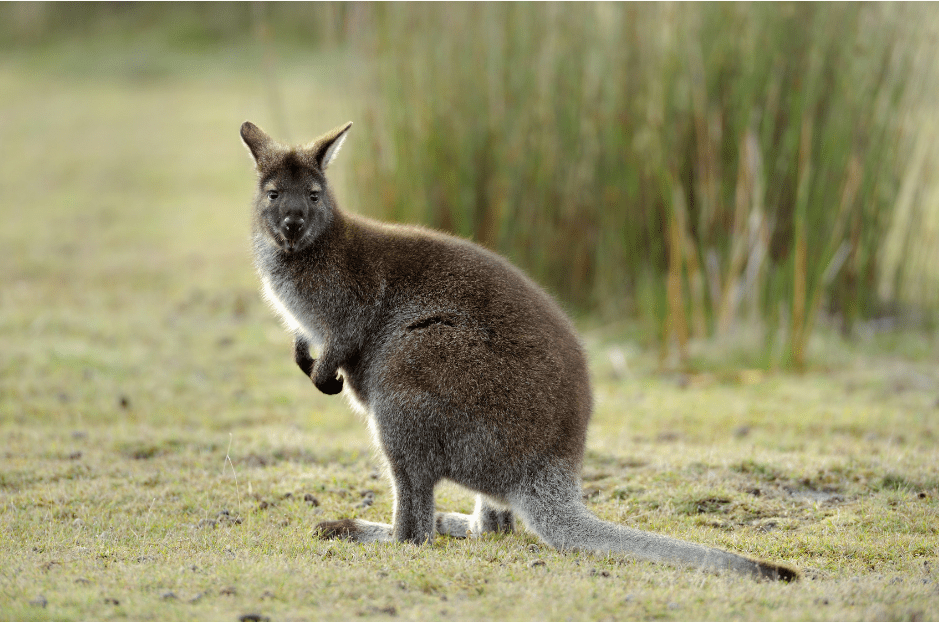
A Wallaby is a marsupial or pouched animal that is a member of the kangaroo family. There are around 30 different species of wallaby (macropod) from the scientific family Macropodidae (Macropodidae means ‘big feet’). Wallabies are smaller than kangaroos and distributed widely across Australia and neighboring islands.
Wallabies are also widespread in New Zealand (introduced), where they are often hunted as they are considered a pest. There are even a few populations of wallabies in the United Kingdom with around 100 individuals residing on the Isle of Man (due to zoo escapees). The name wallaby comes from the Eora Aboriginal tribe who were the original inhabitants of the Sydney area.
Wombat

Wombats (Family: Vombatidae) are small bear-like marsupials found throughout southeastern Australia and Tasmania. They are more closely related to the Koala Bear, however, they are unable to climb trees.
Unlike bears, wombats are not predators but shy, timid animals that can make good, playful, and affectionate pets.
There are 3 species of wombat endemic to Australia with the Common Wombat being the most well-known species. The other 2 species are the Southern Hairy-nosed Wombat (Lasiorhinus latrifrons) and the Northern Hairy-nosed Wombat (Lasiorhinus krefftii).
Quolls

The quoll is a small, carnivorous marsupial that is found in Australia and New Guinea. These animals are nocturnal and feed on a variety of things, including insects, fruits, and buds. Quolls have long hind legs, which allow them to move quickly. They are also known for their strong sense of smell.
Tasmanian Devil

The Tasmanian Devil is a carnivorous marsupial that is found in Australia. It can weigh up to 26 pounds. The Tasmanian Devil has brown fur, and it is known for its loud screeching call. These animals are nocturnal and feed on small animals, such as rabbits, birds, and lizards.
Tasmanian Tiger

The Tasmanian Tiger, also known as the Thylacine, was a carnivorous marsupial that is found in Australia. It was the largest of the carnivorous marsupials in the world, and it could weigh up to 60 pounds. The Tasmanian Tiger had reddish-brown fur, and it was known for its loud screeching call. These animals were nocturnal and feed on small animals, such as rabbits, birds, and lizards. The last known live animal was captured in 1930 in Tasmania.
Bandicoot

The bandicoot is a small, omnivorous marsupial that is found in Australia and New Guinea. These animals are nocturnal and feed on a variety of things, including insects, fruits, and buds. Bandicoots have long hind legs, which allow them to move quickly. They are also known for their strong sense of smell.
Common brushtail possum

The brushtail possum is a marsupial that is found in Australia, New Zealand, and Tasmania. These animals are nocturnal and feed on a variety of things, including insects, fruits, and buds. Brushtail possums have long hind legs, which allow them to move quickly. They are also known for their strong sense of smell.
Cite This Page
APA
Joanne Spencer (2026, May 10). 11 Magnificent Marsupials – Animals with Pouches. Animal Corner. Retrieved 2026, October 5, from https://animalcorner.org/blog/marsupials-animals-with-pouches/
MLA
Joanne Spencer. "11 Magnificent Marsupials – Animals with Pouches." Animal Corner, 2026, May 10, https://animalcorner.org/blog/marsupials-animals-with-pouches/.
Click to copy